The signs your solar panels need cleaning are easy to miss until your electricity bill is already higher than it should be. San Diego gets roughly 265 sunny days a year, but the county also gets marine layer salt film on the coast, inland dust from the desert, and wildfire ash every fall. No significant rainfall for six to eight months means panels get no natural rinse. NREL research puts soiling losses in San Diego at roughly 3-7% per year under average conditions, and that number climbs fast when you add bird droppings or ash events.
Here are the seven concrete signs that your system needs attention.
The signs to watch for
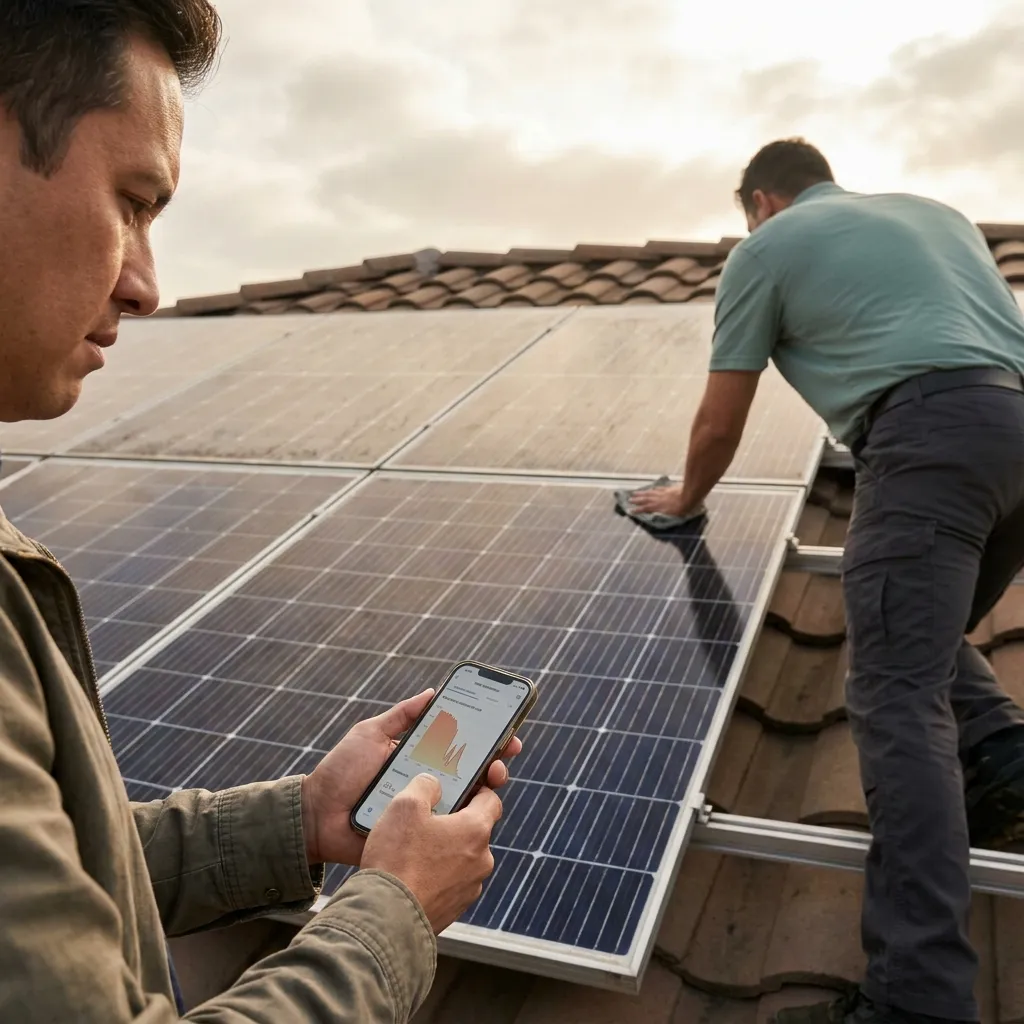
1. Your monitoring app shows a production dip
Your monitoring portal, Enphase Enlighten, SolarEdge, Tesla, or SunPower, logs daily kilowatt-hour output. Pull up production for a clear sunny day and compare it to the same type of day three to six months ago. A drop of 5% or more with no shading change and no inverter errors is a strong signal that soiling is costing you real kilowatts. This is the most reliable sign because it shows you exactly what the dirt is taking.
If you want a deeper look, our performance monitoring service benchmarks your system against expected output for your panel model, tilt, and local weather.
2. You can see a film, dust layer, or streaks
Stand at ground level or look from a second-story window on a bright morning. A healthy panel reflects cleanly. A panel that needs cleaning looks dull, hazy, or shows visible dust lines where debris has settled along the frame. Coastal neighborhoods in San Diego, Pacific Beach, La Jolla, Del Mar, often develop a thin salt film from marine layer that is almost invisible individually but cuts transmission across the whole array.
3. Bird droppings or nesting material is present
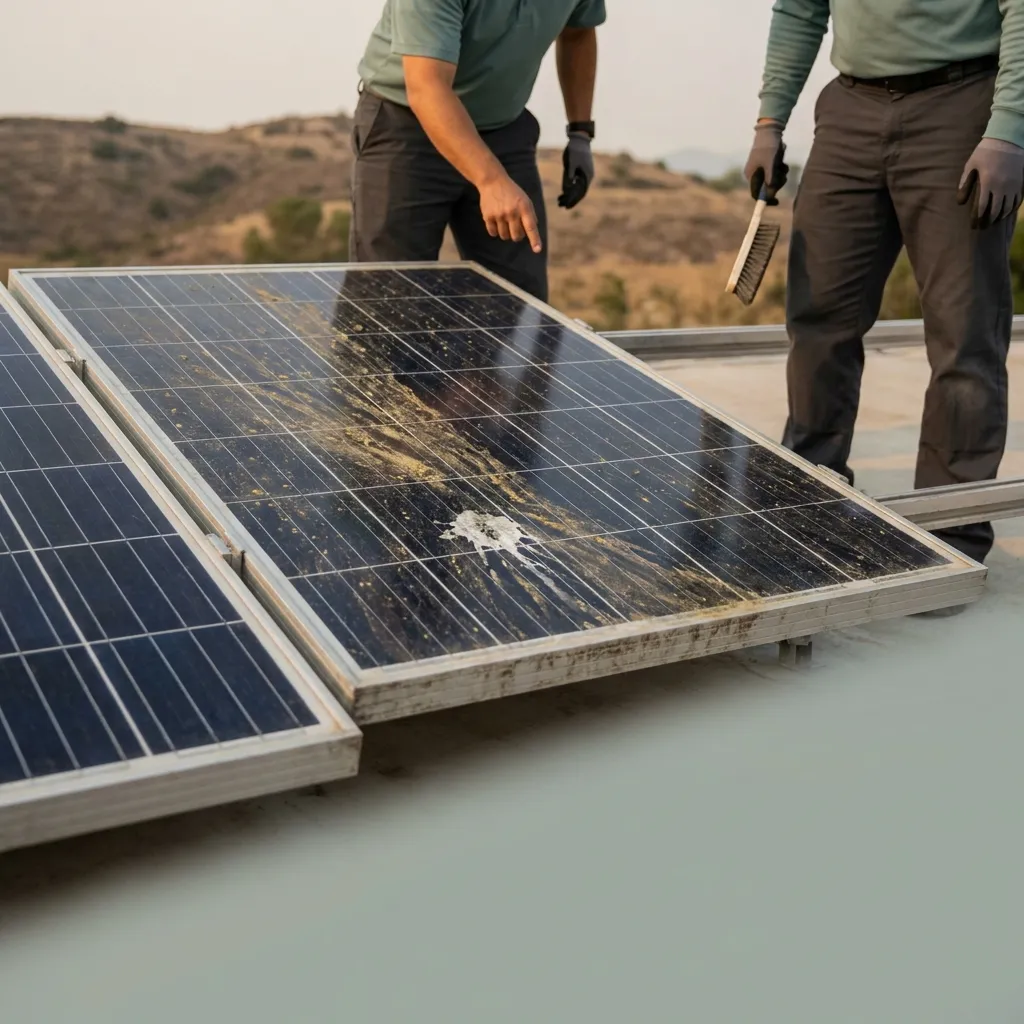
Bird droppings are a concentrated soiling problem. Unlike dust, a dropping blocks one spot entirely instead of reducing output evenly across the panel. A single dropping over a cell can reduce that panel’s output by 30-40% depending on where it sits in the string. If you see droppings regularly, it is worth asking whether birds are nesting under or between your panels, that creates a recurring problem, not a one-time cleaning job. Our bird proofing service installs critter guards that stop nesting at the source.
4. Your electricity bill is higher with no usage change
Your bill going up while your habits stay the same is a downstream version of sign one. If your system was previously offsetting 85-90% of your usage and that number has slipped, and you have ruled out rate increases, a dirty array is the likely cause. Pull twelve months of utility statements and compare the net usage trend against a period when panels were recently cleaned.
5. It has been six to twelve months since your last cleaning
San Diego’s dry season runs roughly May through October with almost no rainfall. That is five to six months of accumulated dust, pollen, and marine salt with no washout. If you cannot remember the last time your panels were cleaned, or if you have never had them cleaned since installation, the interval alone is a reason to schedule service. Learn more about how often to clean solar panels in San Diego based on your specific neighborhood and system type.
6. Sprinkler overspray has left hard water spots
Hard water from irrigation systems is a common issue in San Diego’s inland neighborhoods, Escondido, Santee, El Cajon, Spring Valley. Sprinklers that clip the edge of a roofline leave mineral deposits that dry into calcium spots. These spots are not removed by rain and require a proper deionized-water rinse to clear without leaving new residue. Hard water spotting also builds up faster than dust, which means the performance impact compounds between cleanings.
7. You have had an ash, pollen, or construction dust event
Wildfire ash from San Diego and Riverside County fires settles across every surface, panels included. Ash is particularly damaging because it is fine, slightly acidic, and mixes with dew to form a paste that bonds to glass. Pollen season in spring and early summer adds another layer in neighborhoods near canyons and open space. Construction on a neighboring property kicks up silica dust that does the same. After any of these events, do not wait for the next scheduled cleaning. Schedule an inspection and cleaning as soon as the air quality clears.
Quick self-check table
| Sign | What it means | Urgency |
|---|---|---|
| Production dip on monitoring app | Soiling reducing output measurably | High, schedule soon |
| Visible dust film or haze | Surface soiling across the array | Medium, within 30 days |
| Bird droppings | Concentrated cell blocking | High, plus consider bird proofing |
| Higher electricity bill | Lost offset from dirty panels | Medium, verify with monitoring data |
| 6-12 months since last cleaning | Dry-season accumulation | Medium, routine maintenance due |
| Hard water spots from sprinklers | Mineral deposits bonded to glass | High, requires deionized rinse |
| Post-ash or post-pollen event | Residue that bonds with moisture | High, clean within one to two weeks |
Does cleaning actually help?
Yes, consistently. NREL data on soiling losses in arid climates, which describes most of San Diego County, shows panels recovering their full rated output after a proper cleaning. The recovery is most dramatic after long dry stretches and after ash events. A professional solar panel cleaning uses purified, deionized water so there is no mineral residue left behind, unlike a garden hose rinse, which can make hard water spotting worse.
If you are weighing whether to clean at all, this breakdown of whether solar panels need to be cleaned covers the full cost-benefit picture. And if you want to understand the direct production impact, read how cleaning increases solar output in San Diego with real before-and-after output numbers.
For technical soiling research, NREL publishes detailed findings at nrel.gov.
When to call us
If you spotted two or more of these signs, your system is likely underperforming right now. The good news is that a cleaning typically restores full output within one production day.
Call us at (858) 925-5546 for a free production check and quote. We serve all of San Diego County, from coastal Encinitas and Chula Vista to inland El Cajon and Escondido. We will check your monitoring data, assess the soiling, and give you a straight answer on what your system needs.