Flat roof solar panel cleaning is a different task than washing panels on a steep residential roof, and the difference matters to your bottom line. On a shallow or flat surface, dust and marine grime don’t run off between rains, they pool, dry, and bond to the glass. NREL research consistently shows that soiling losses on low-tilt commercial arrays can run two to four times higher than on steep-tilt residential panels, which means a 500 kW rooftop system in Kearny Mesa could be losing more power to dirt than the building manager realizes. This guide explains what flat-roof solar panel cleaning involves in San Diego, how often it should happen, and what a professional visit actually delivers.
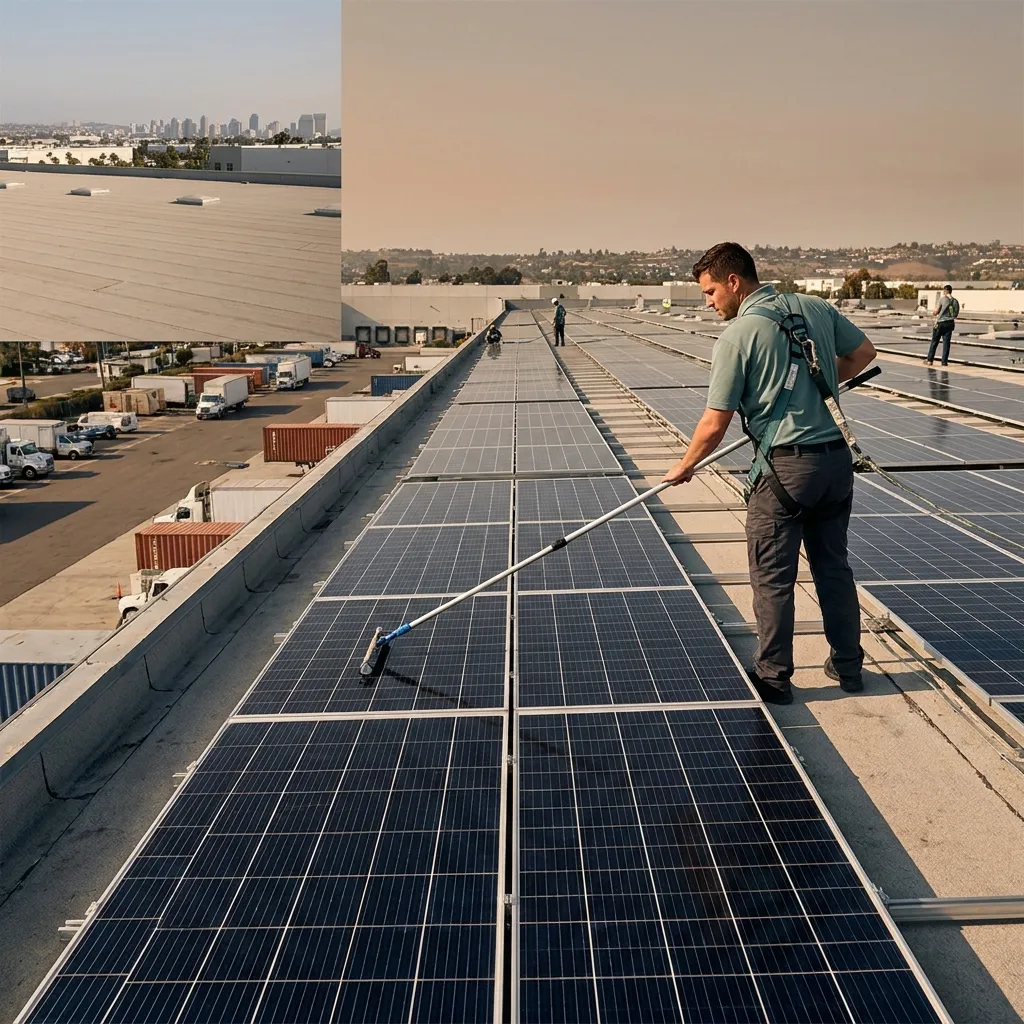
Why flat and low-tilt arrays soil faster
Panel tilt is the single biggest factor in self-cleaning. A residential panel at 30 degrees sheds most of its light dust during a coastal fog event or a light rain. A commercial panel at 5 to 10 degrees doesn’t move water fast enough to carry particulates off the surface.
San Diego compounds this with a specific mix of soiling sources:
- Coastal marine layer deposits salt residue across Kearny Mesa, Miramar, and Sorrento Valley panels overnight.
- Traffic and industrial particulate from the I-15 and I-805 corridors settles on Otay Mesa and Miramar industrial rooftops throughout the day.
- Bird and pest activity is heavier on flat commercial roofs than on steep residential installations.
- Pollen and organic debris from landscaped business parks in Carlsbad and Vista sticks well to glass that doesn’t drain.
The practical result is that a flat-roof array in San Diego accumulates enough soiling to warrant cleaning every 60 to 90 days in high-particulate areas, versus two to three times per year for a typical residential install.
What a professional cleaning visit covers on a flat roof
Cleaning a flat commercial roof isn’t just a matter of running a hose across the panels. A proper visit includes safety planning, surface protection, and documentation.
Access and fall protection
OSHA regulations for rooftop work require either a fall-arrest system, guardrails, or a safety monitor depending on the roof height and configuration. For taller buildings, downtown high-rises, hotels, or multi-story office parks, that may mean a crane, a suspended platform, or a boom lift staged in the parking structure. We plan access before the crew arrives so no time is lost on-site.
Soft-wash deionized water method
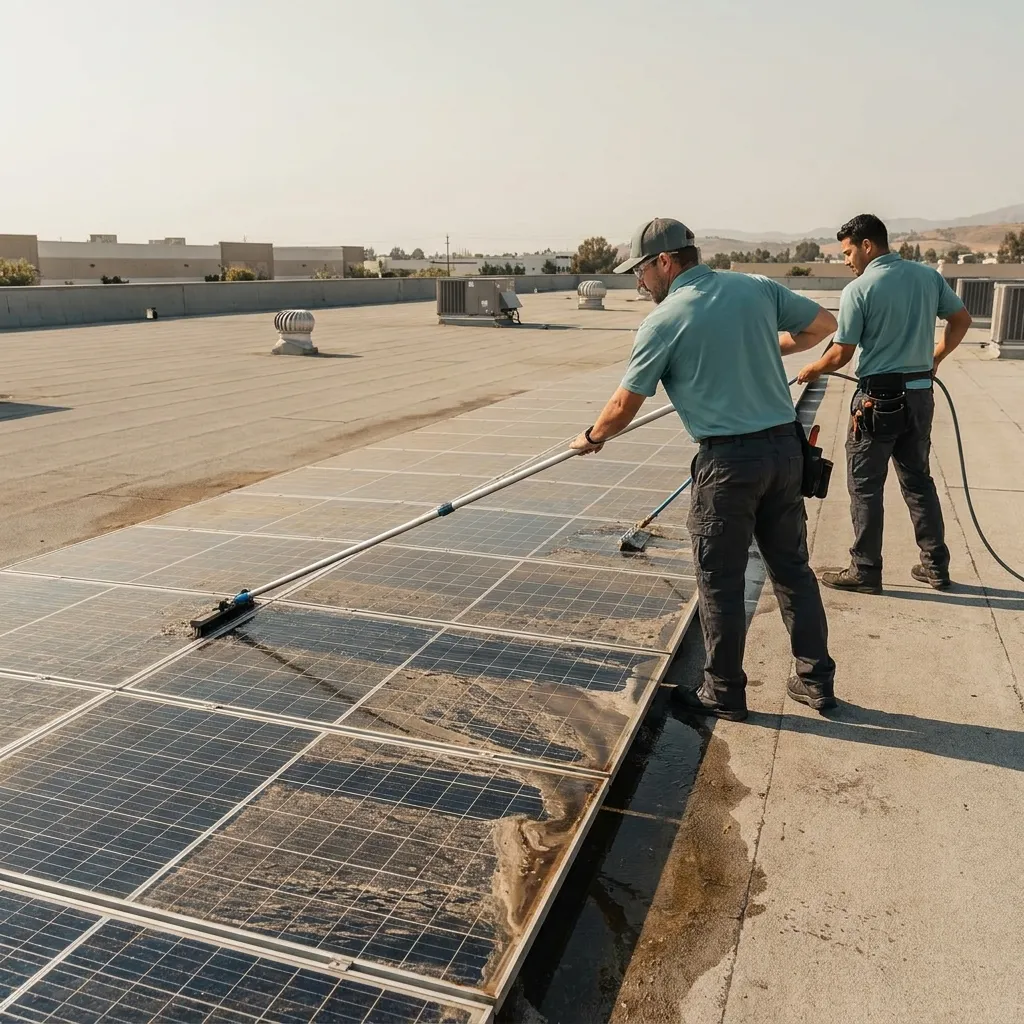
We use water-fed poles with deionized water, delivered at low pressure. Deionized water leaves no mineral deposits when it dries, which means panels come out streak-free without chemical residue. The low-pressure approach protects panel seals and junction boxes that a pressure washer would eventually compromise.
For heavier soiling, hardened bird droppings, salt crust, or oil film near delivery areas, we apply a biodegradable panel-safe solution before the rinse cycle.
Roof membrane and ballast protection
Most flat commercial roofs use a TPO or EPDM membrane with ballasted racking. Heavy foot traffic in the wrong areas, or dragging equipment across ballast, damages the membrane and voids roofing warranties. Our crews walk established pathways, use padded equipment staging, and avoid concentrated point loads on single-ply membranes.
Scheduling to minimize tenant and operations disruption
Facility managers at retail centers, hotels, and schools need cleaning visits that don’t interfere with business hours. We schedule most commercial work in overnight or early-morning windows: work begins at 5 or 6 a.m. and wraps before the building opens. For sites with loading dock conflicts or tenant parking constraints, we coordinate access windows in advance with your facilities team.
Related: how often you should clean your solar panels in San Diego.
What soiling actually costs on a large commercial array
NREL’s soiling studies (see nrel.gov) show average annual energy losses from soiling in the 1.5 to 6.2 percent range depending on location, tilt, and local particulate levels. San Diego’s coastal and urban mix puts most commercial sites in the middle to upper end of that range.
For a 500 kW system generating around 750,000 kWh per year under SDG&E commercial rates, a 4 percent soiling loss is roughly 30,000 kWh, or several thousand dollars in lost generation annually. Cleaning contracts typically cost a fraction of that. The SDG&E business rate schedule makes it straightforward to run your own calculation once you know your annual kWh target.
Here’s a quick reference for common San Diego commercial site types:
| Site type | Typical array size | Recommended cadence |
|---|---|---|
| Warehouse / distribution | 200 kW to 1 MW+ | Every 60-90 days |
| Office park | 50-300 kW | Every 90 days |
| Retail / strip center | 30-150 kW | Every 60-90 days |
| Hotel / hospitality | 50-500 kW | Every 60 days |
| K-12 school | 50-300 kW | 3-4 times per year |
| Self-storage facility | 30-200 kW | Every 90 days |
What a commercial cleaning contract includes
A one-off cleaning visit fixes today’s soiling. A maintenance contract protects production across the whole year and gives facility managers documentation they can share with ownership or lenders.
Our commercial maintenance contracts include:
- Scheduled cleaning cadence, quarterly, semi-annual, or custom based on your site’s soiling rate
- Production-recovery reporting, before-and-after meter readings or inverter data showing the generation lift from each visit
- Certificate of insurance, required by most property managers and building owners before any rooftop work
- Coordination with your asset manager or energy manager, so you’re not managing paperwork from multiple vendors
For more on what ongoing maintenance covers, see our solar maintenance plan and performance monitoring service pages.
Common San Diego commercial locations we serve
Most of our commercial flat-roof work runs across:
- Kearny Mesa and Miramar, high-density industrial and light-manufacturing rooftops
- Sorrento Valley, biotech and office campuses with large rooftop arrays
- Otay Mesa, logistics and distribution centers with some of the largest rooftop systems in the county
- Carlsbad and Vista business parks, mid-size commercial with mixed retail and office
- Downtown and Bankers Hill, multi-story buildings requiring lift or suspended-platform access
If your site isn’t on this list, we still cover it. We serve all of San Diego County.
For a broader look at commercial cleaning across building types, see our commercial solar panel cleaning overview and our soft-wash cleaning service page.
When to call us
If your array is on a flat or low-tilt commercial roof and you haven’t had a professional cleaning in the last 90 days, it’s worth a site visit. Soiling compounds, the longer panels stay dirty, the harder the residue bonds to the glass. Early cleaning is cheaper than chemical treatment later.
Call us at (858) 925-5546 for a commercial solar cleaning quote. We’ll assess your roof access, soiling level, and array size, then give you a maintenance cadence and pricing that fits your facility’s schedule. We also offer commercial solar cleaning service contracts with production reporting included.