The short answer to whether solar panels clean themselves when it rains: no, not really. Rain knocks off some loose dry dust, but in San Diego it mostly just moves grime around, leaves mineral deposits as it dries, and does nothing for bird droppings, salt film, or the baked-on buildup that accumulates through six months of dry weather. If you’re counting on rain to maintain your system, you’re losing output.
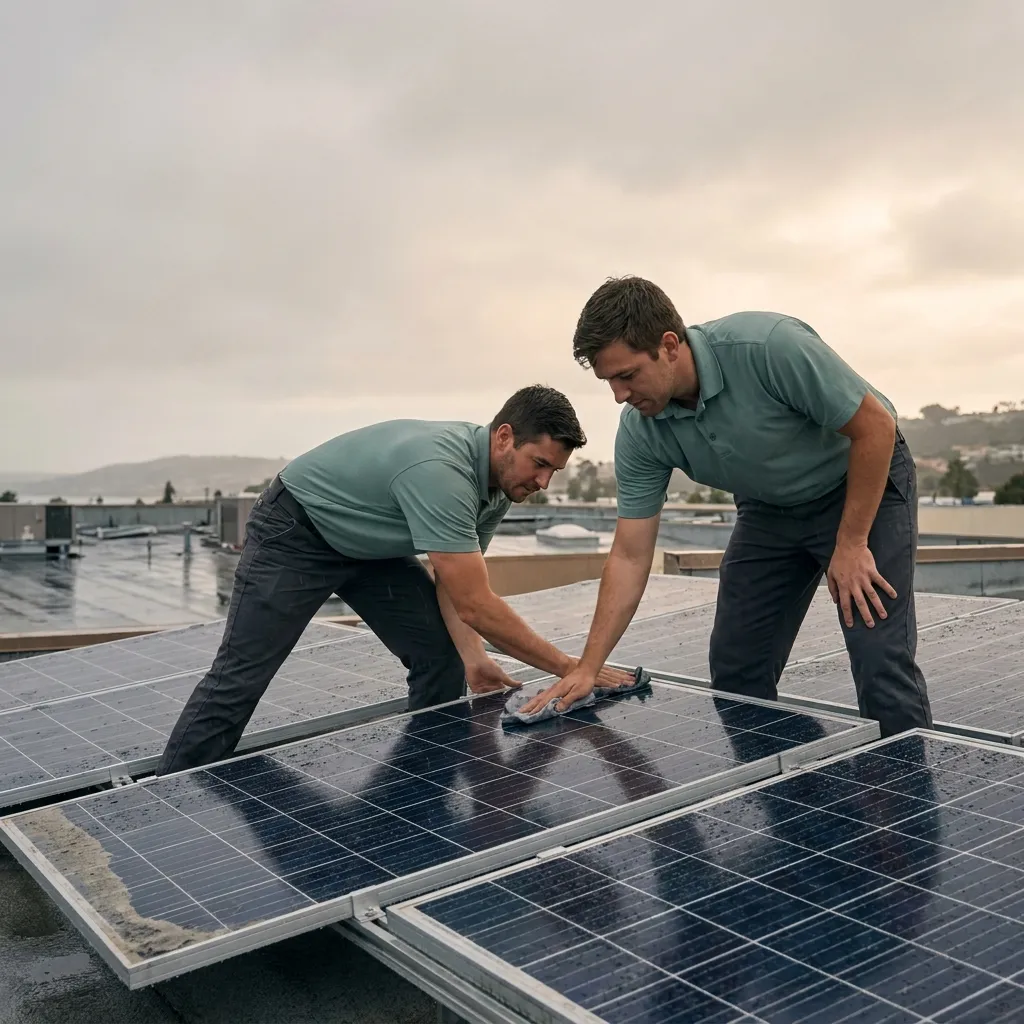
Why rain doesn’t actually clean solar panels
Water sounds like it should do the job. It’s wet, it falls from the sky, it rinses things. But panel glass isn’t a non-stick surface. Dust, pollen, salt particles, and exhaust residue stick to it, and water alone doesn’t have the surfactant power to break that bond.
When rain hits a panel that already has a layer of dust, two things happen. First, the water mixes with the dust and creates a thin slurry. Second, that slurry runs to the edges of the panel and dries there, leaving a concentrated ring of debris. That’s the opposite of clean.
As the water evaporates, any minerals it carried from the air or from the panel surface get left behind. San Diego’s tap water and coastal air both carry dissolved minerals. Every rain event deposits a new layer of those minerals as the water dries.
What San Diego rain actually looks like, by the numbers
San Diego averages roughly 10 inches of rain per year, nearly all of it falling between November and March. From late April through October, most of the county gets close to zero rainfall. That dry stretch covers the highest solar production months of the year.
So for the six or seven months when your panels are working hardest, there’s no rain at all. Any grime that builds up during that period stays put until you remove it. NREL research puts soiling losses for systems in regions like San Diego at roughly 3 to 7 percent per year, and that loss accelerates the longer panels go without cleaning.
| Season | Avg Rainfall | Cleaning Value |
|---|---|---|
| Nov to Mar | ~8-10 in total | Minimal; leaves mineral residue |
| Apr to Jun | Trace amounts | Near zero |
| Jul to Oct | Near zero | None |
The panels that benefit most from rain are those on steeply pitched roofs in climates with heavy, frequent downpours. San Diego is neither of those things.
The marine layer problem
Coastal San Diego has another issue: the marine layer. Morning fog and low clouds roll in off the Pacific and deposit a fine layer of salt on everything, including your panels. Unlike rain, marine layer moisture evaporates quickly without any rinsing effect. It just leaves salt film behind.
That salt film reduces the amount of light that passes through the glass. It also acts as a bonding agent for dust that settles later, making the surface harder to clean over time. Professional solar panel cleaning removes salt film in a way that rain can’t.
What about self-cleaning coatings?
Some panel manufacturers apply hydrophobic coatings that cause water to bead and roll off rather than spread and dry flat. These coatings are real and they help. They reduce the rate at which mineral deposits form, and they improve the odds that light rain will carry some loose particles off the surface.
They don’t eliminate soiling. Coatings degrade over time under UV exposure. They do nothing for stuck-on bird droppings, tree sap, or the edge buildup that forms over months. And in San Diego, where most buildup happens during a dry season with no rain to trigger the coating’s water-beading effect, they provide very little practical benefit between cleanings.
What rain can and can’t do
It’s worth being fair here. Rain isn’t useless.
Rain can:
- Knock loose, dry dust off panels on steeply pitched roofs
- Provide a light pre-rinse before a manual cleaning
- Slow down the pace of buildup slightly during winter months
Rain can’t:
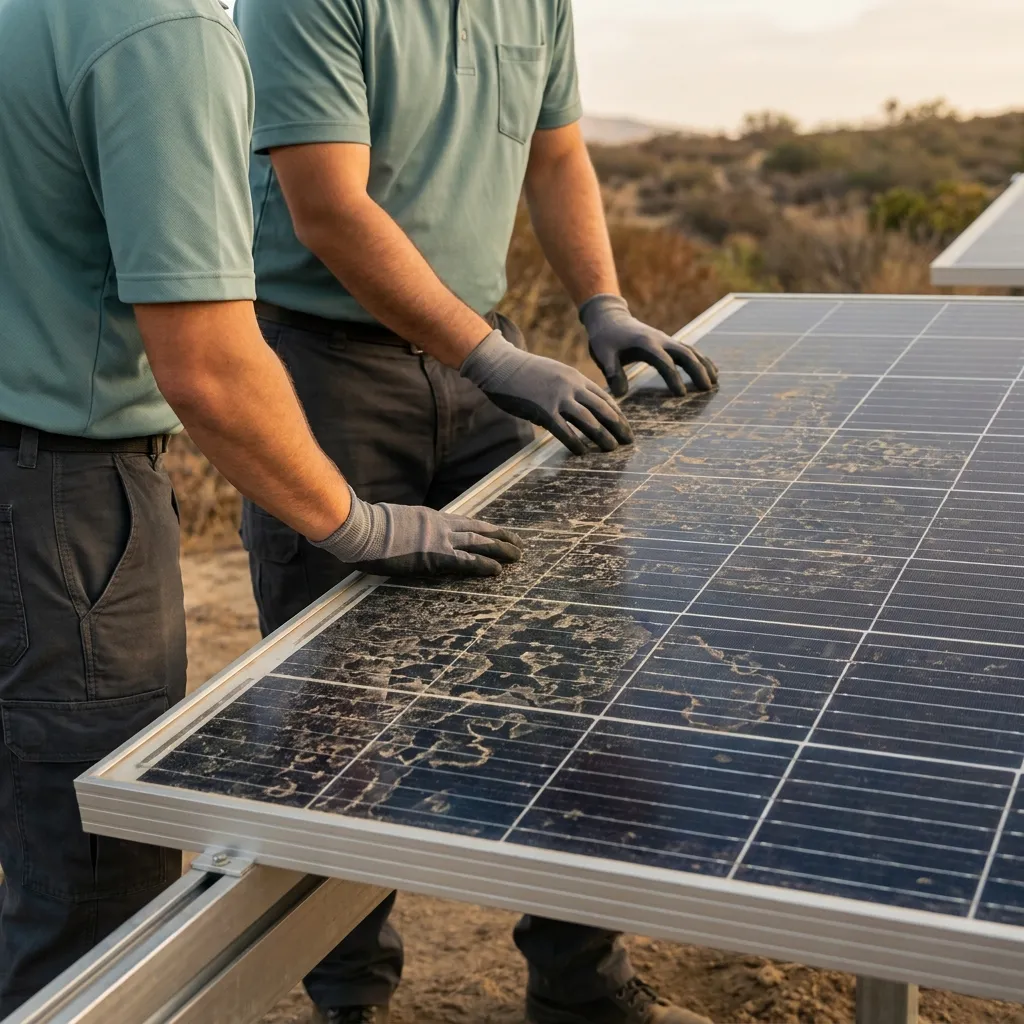
- Remove bird droppings, which are acidic and bond to glass
- Break down hard water stains or mineral scale
- Rinse salt film deposited by marine air
- Replace cleaning during a six-month dry season
- Clean panels with a low pitch, where water pools and evaporates instead of running off
If you’re seeing water spots on your panels after rain, that’s mineral residue from hard water stain buildup. Those spots don’t go away on their own.
How often San Diego panels actually need cleaning
Because rainfall is so infrequent and the dry season is so long, most San Diego solar systems need professional cleaning two times per year. Once in spring before peak production season, and once in fall after the summer dust and smoke season. Systems near the coast or in areas with heavy bird activity may need it three times.
This is consistent with what NREL recommends for arid climates with low annual rainfall (nrel.gov). San Diego’s Mediterranean climate puts it squarely in that category.
For a full breakdown, read our post on how often to clean solar panels in San Diego and whether solar panels actually need to be cleaned at all.
What dirty panels actually cost you
A 3 to 7 percent annual output loss sounds modest. On a 10 kW system producing 17,000 kWh per year, that’s 500 to 1,200 kWh lost, worth $100 to $250 at current San Diego energy rates, and climbing as rates increase. Over the 25-year life of the system, you’re looking at a meaningful number.
That’s before accounting for the fact that soiling isn’t linear. Panels that go 12 to 18 months without cleaning in a dry, dusty climate can see losses well above 7 percent. NREL data shows soiling can cut output by 25 percent or more in extreme cases.
Professional cleaning costs far less than the lost production. There’s also the longevity factor: dirt, salt, and acidic droppings that sit on glass for months cause micro-etching. Over time, that affects how much light the glass transmits even after cleaning. A soft wash cleaning approach removes contaminants without scratching the surface.
Our post on whether cleaning increases solar output in San Diego walks through the production numbers in more detail.
When to call us
If your panels haven’t been cleaned since last fall, or if you can’t remember the last time they were cleaned, they’re almost certainly costing you production. Bird droppings, mineral scale, and coastal salt film don’t wait for rain to fix themselves.
Call us at (858) 925-5546 for a free quote. We serve all of San Diego County, and we can usually get you scheduled within a week.