Pigeons under solar panels is one of the most common complaints we hear from San Diego homeowners, and one of the most damaging problems you can ignore. The short answer: you need humane nest removal, a thorough cleaning to clear the droppings and debris, and a physical barrier (critter guard mesh) sealed around the array perimeter. Do all three, or the birds will be back within weeks.
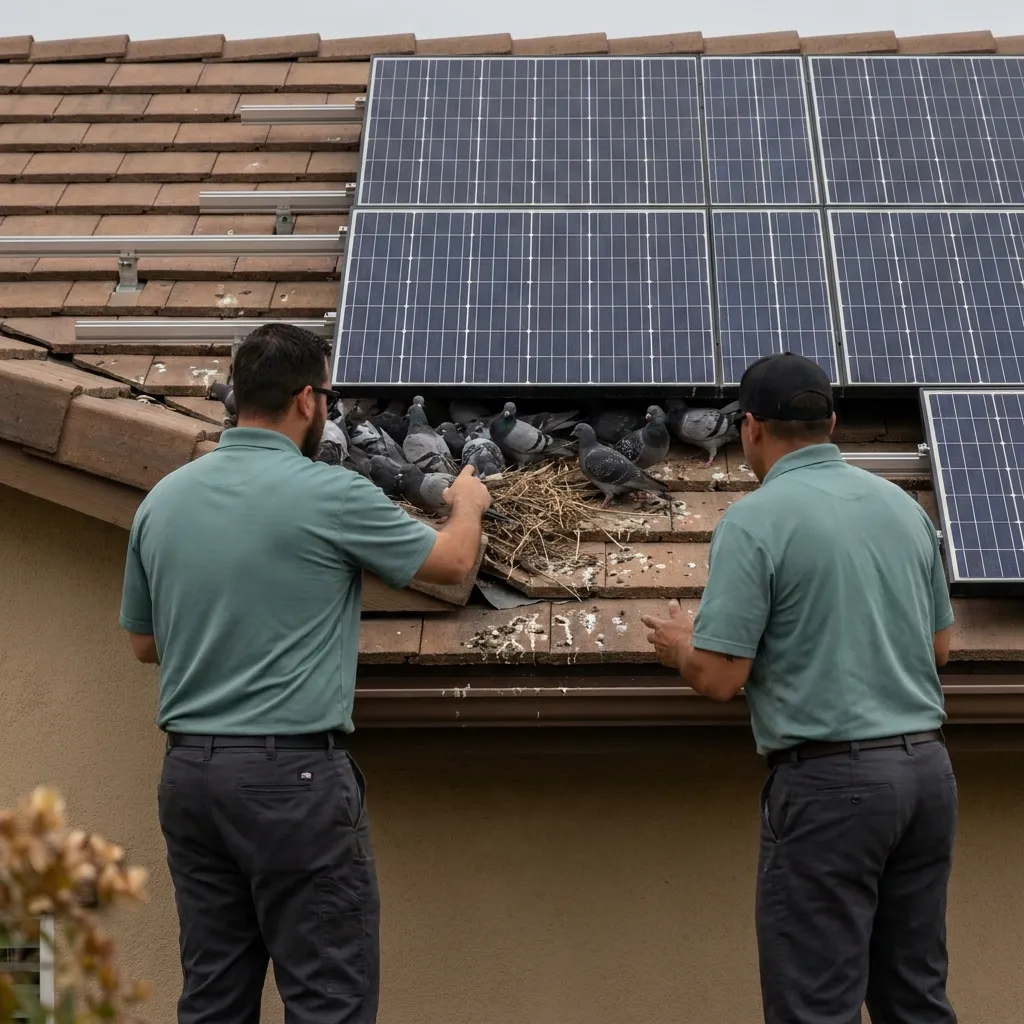
Why birds love the gap under your panels
Solar panels sit a few inches above your roof surface. That gap is warm, sheltered from wind and rain, and hidden from hawks and other predators. For a pigeon, it’s close to perfect nesting real estate.
San Diego makes the problem worse. Coastal areas, Ocean Beach, Point Loma, Mission Beach, have heavy gull and pigeon populations year-round. Inland neighborhoods from El Cajon to Santee deal with a steady pigeon population too. Sparrows, starlings, and even rats and squirrels will exploit the same gap when they find it unoccupied.
Once one pair nests, others follow. Pigeons are social and will return to a site repeatedly if nothing changes.
The damage pigeons actually cause
This isn’t just a noise or nuisance problem. Here’s what’s happening to your system while birds nest underneath it.
Droppings etch glass and roofing
Pigeon droppings are highly acidic. Left on panel glass, they create permanent etching that can’t be removed by rain and reduces light transmission. On roofing tiles and flashing, the same acidity accelerates degradation over time.
Nesting debris traps heat and blocks airflow
Panels need airflow underneath to stay cool. Straw, feathers, twigs, and dried droppings pack tightly into the gap and act as insulation, in the wrong direction. Overheating panels produce less power. A study from the National Renewable Energy Laboratory (nrel.gov) documents how elevated cell temperatures directly reduce output. Nesting debris is a real and underappreciated contributor to this.
Chewed wiring is a fire risk
Rats and squirrels follow pigeons. Once the gap is occupied, rodents will use it too, and they chew wiring. Damaged DC wiring under panels is a known fire risk. This is the damage that costs thousands to fix, or worse.
Clogged gutters and attic contamination
Nesting material and droppings wash off the roof into gutters during rain and block them. In some cases, birds enter the attic through gaps near the fascia. Bird mites from an active nest can migrate into living spaces.
How to tell if you have a nesting problem
You don’t always need to climb on the roof to spot signs. Look for these:
- Pigeons landing on your roof repeatedly, especially along the panel edges
- Cooing or scratching sounds from the ceiling during early morning
- Droppings concentrated in one area below a section of your roof
- Nesting material visible at the edge of the array from the ground
- A noticeable drop in production from one string of panels (check your monitoring app)
If you’re seeing any of these, the nest is likely already established. An inspection will confirm the extent of the problem.
The right fix: removal, cleaning, then critter guard
There’s a sequence that matters here. Skipping steps leads to recurring infestations and ongoing damage.
Step 1: Humane nest and debris removal
Active nests with eggs or chicks require care under California law. Migratory bird protections apply to many species. A professional removes nesting material, eggs, and debris without harming birds, and disposes of it properly. This step also includes clearing droppings from the roof surface, gutters, and any contaminated areas.
Step 2: Deep cleaning
After removal, the panels and surrounding roof area need a professional solar panel cleaning. Bird droppings bond to glass and require the right technique, typically a soft-wash approach with appropriate cleaning solution. Hard scrubbing or pressure washing can damage anti-reflective coatings. A proper soft-wash cleaning removes acid residue, streaking, and biological material without scratching the surface.
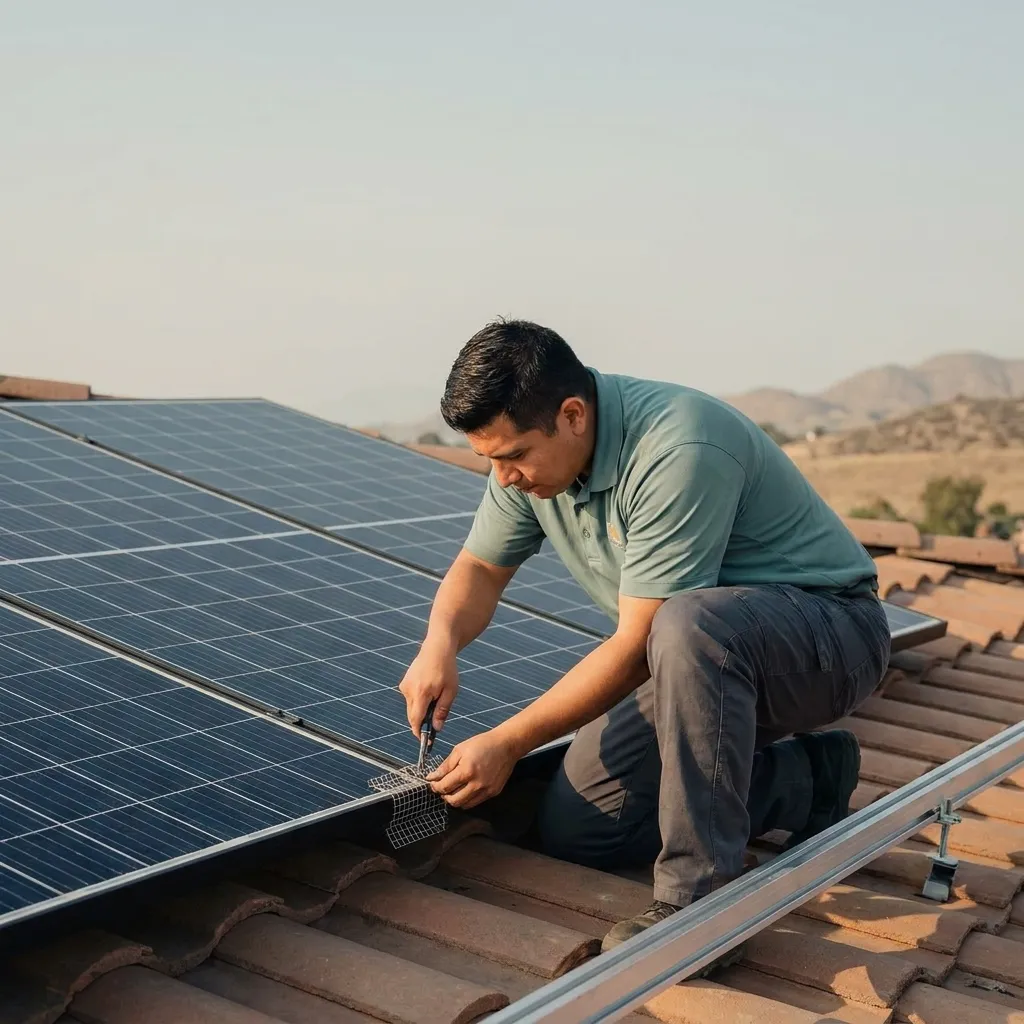
Step 3: Critter guard installation
Once the area is clean, bird-proofing mesh goes up around the full perimeter of the array. Stainless-steel mesh or UV-stabilized polypropylene clips attach to the panel frames and seal the gap between the panel edge and the roof. It blocks birds and rodents without restricting airflow, without penetrating the roof, and without voiding panel warranties when installed correctly.
This is the only step that actually prevents the problem from recurring. Repellents, decoys, and spike strips applied to the panels themselves have poor long-term results. Physical exclusion works.
What critter guard does not do
It’s worth being clear about what the mesh won’t fix on its own. If droppings are already on the glass and etching has started, the mesh won’t restore production, that requires cleaning first. If wiring has already been damaged by rodents, that needs electrical inspection before any other work. And if an active infestation is in progress, the mesh goes on last, not first.
| Step | Why it matters | When to skip it |
|---|---|---|
| Nest and debris removal | Clears the source of ongoing contamination | Never, skipping leads to smell, mites, clogged gutters |
| Deep cleaning | Removes acidic droppings before they etch permanently | Never, mesh alone won’t fix production loss |
| Critter guard installation | Prevents reinfestation | Only if panels are being removed or replaced soon |
How this pairs with your regular maintenance
If you’re already on a regular cleaning schedule, bird-proofing integrates well into the same visit. We assess the perimeter seals on every cleaning call and flag gaps before they become full infestations. Owners who get the mesh installed and keep up with annual or twice-yearly cleanings rarely deal with this problem again.
For context on what cleaning alone does for production, see our post on whether solar panels need to be cleaned. And if you’re dealing specifically with bird-proofing questions, our deeper guide on bird-proofing solar panels in San Diego covers material choices and installation details.
When to call us
If you’re seeing birds on your roof, hearing noise under your panels, or your monitoring app is showing lower output from one section of the array, don’t wait. The longer a nest is established, the more cleaning is needed and the higher the risk of wiring damage.
Call us at (858) 925-5546 for a free bird-proofing and cleaning quote. We serve all of San Diego County and can usually schedule an assessment within a few days.