Solar panel cleaning in Vista, CA matters more than most homeowners expect. Vista sits several miles inland in North County, where coastal marine air gives way to dusty chaparral, agricultural pollen, and long rainless summers. That combination coats panels faster than nearly anywhere else in San Diego County, and dirty panels quietly bleed output month after month. The short answer: most Vista homes need a professional cleaning at least twice a year, and homes under heavy tree cover need it every quarter.
Why Vista’s environment is harder on solar panels than coastal areas
Vista’s inland location changes the soiling equation in a few key ways.
Dust and agricultural debris. Vista has a long history of nurseries, avocado groves, and flower farms in the surrounding hills. That means pollen, fine soil, and organic dust travel on the afternoon winds and settle on panel glass. During spring bloom, pollen accumulation can be dramatic.
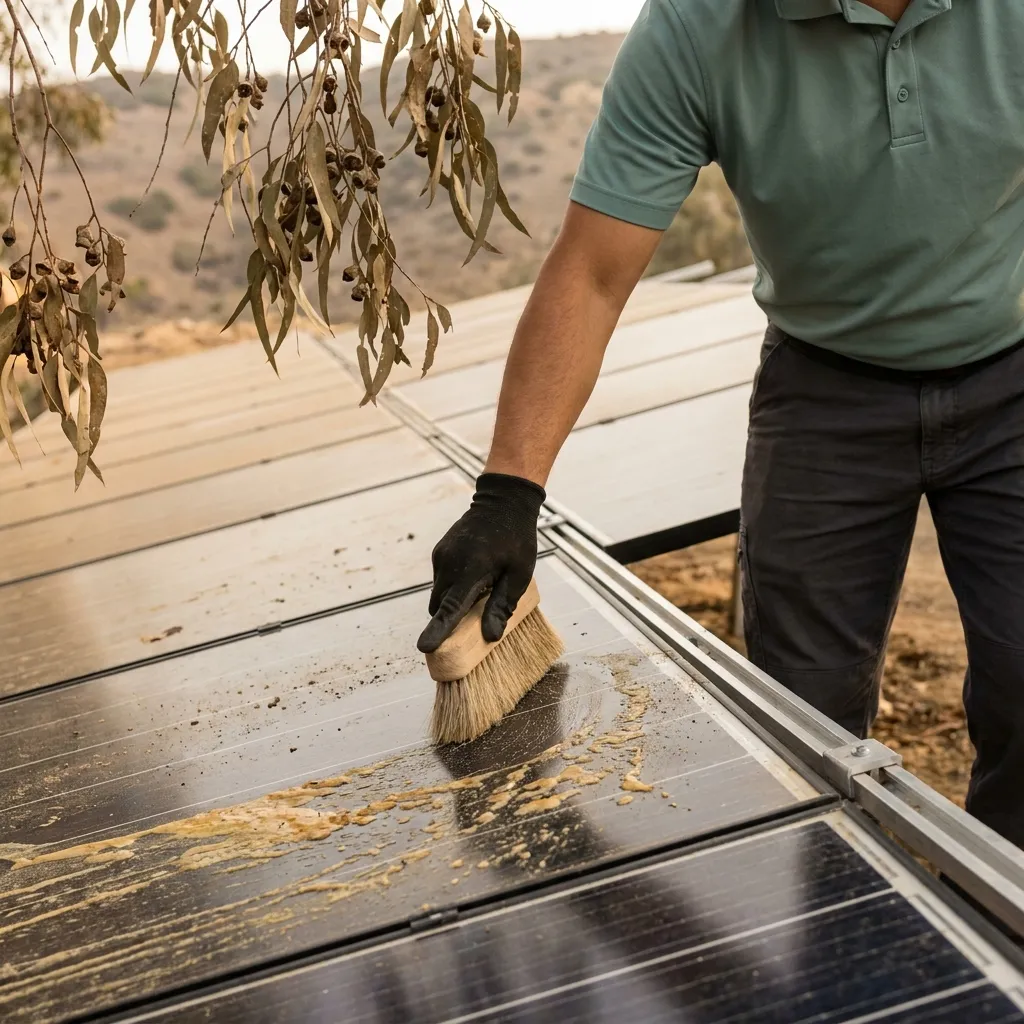
Tree cover in established neighborhoods. Areas like Shadowridge, Buena Vista Creek, and the older Vista Village core have mature oak, eucalyptus, and pepper trees. Those drop leaf fragments, seed pods, and sticky sap directly onto arrays. Sap is one of the harder contaminants to remove and will not rinse off with rain.
Hard water mineral deposits. Vista’s water supply carries dissolved calcium and magnesium. Every time a sprinkler grazes a panel, or even a light marine drizzle evaporates, it leaves a mineral film behind. Over time these spots bond to the glass and resist simple rinsing. Professional hard water stain removal uses the right tools and filtered water to dissolve them without scratching.
Long dry spells and wildfire ash. Vista regularly goes five to seven months with almost no measurable rain. Soiling builds unchecked. In fire season, ash from inland fires can coat an array within hours. Ash is fine, abrasive, and slightly acidic, it needs a gentle but thorough wash rather than a high-pressure blast.
Research from the National Renewable Energy Laboratory puts annual soiling losses for San Diego-area systems at roughly 3 to 7 percent per year. Inland locations like Vista trend toward the higher end of that range because rainfall does less of the natural cleaning work that coastal sites get from marine air and fog.
How much energy do dirty panels actually lose?
A 7 percent annual loss on a 10-kilowatt system producing 15,000 kWh per year works out to about 1,050 kWh gone. At SDG&E’s tiered residential rates, often $0.45 to $0.55 per kWh in the upper tiers, that’s $470 to $580 in lost value every year. Two professional cleanings cost a fraction of that.
The losses compound differently depending on the soiling type. A uniform light-dust coat reduces output proportionally across all panels. But shading from a bird dropping or a sap spot on a single cell can trigger bypass diodes that knock out an entire string. That kind of localized contamination can cut a system’s output by far more than the affected area would suggest. SDG&E’s solar resources page explains how system monitoring can help you spot unusual output dips, a useful first signal that cleaning is overdue.
How often should Vista homeowners clean their solar panels?
The honest answer depends on your specific yard and roof situation. Here’s a practical guide:
| Situation | Recommended frequency |
|---|---|
| Open roof, no trees nearby | Every 6 months |
| Oak, eucalyptus, or pepper trees within 30 feet | Every 3 months |
| Sprinkler overspray reaching panels | Every 3-4 months |
| Heavy fire season ash event | Clean within 2 weeks of event |
| Post-construction or remodel dust | Clean before next production month |
Newer tracts built between 2017 and 2022, common in Vista’s eastern and northern edges, often have panels on west- and south-facing orientations with minimal tree interference. Semi-annual cleaning usually handles those well. Homes in established Shadowridge or near the Buena Vista Creek open space, where oak canopy is dense, will see visible debris within weeks of a cleaning.
Our solar maintenance plan takes the guesswork out of scheduling. We track your system, remind you when service is due, and adjust frequency if we see heavier-than-normal buildup.
What does solar panel cleaning cost in Vista?
For a standard residential system in Vista, expect to pay:
- $150 to $250 for systems up to 20 panels on a single-story roof
- $200 to $300 for systems up to 30 panels or two-story access
- $5 to $15 per panel for larger or commercial arrays
Hard water stain treatment, when mineral deposits have bonded to the glass, adds to the base price depending on severity. Most homeowners find that the output gain after a good cleaning pays for itself within one to two billing cycles.
Get a firm quote before any work starts. The price range above covers the Vista area specifically, steep or complex roof geometry can affect cost. You can also read our full breakdown in solar panel cleaning cost in San Diego.
What the cleaning process looks like
Professional cleaning is not a garden hose rinse. Here’s what a proper service includes:
Pre-inspection. We check for cracked glass, damaged frames, loose wiring, and pest activity (pigeons and squirrels love the space under panels in Vista’s neighborhoods). Any issues get flagged before we start.
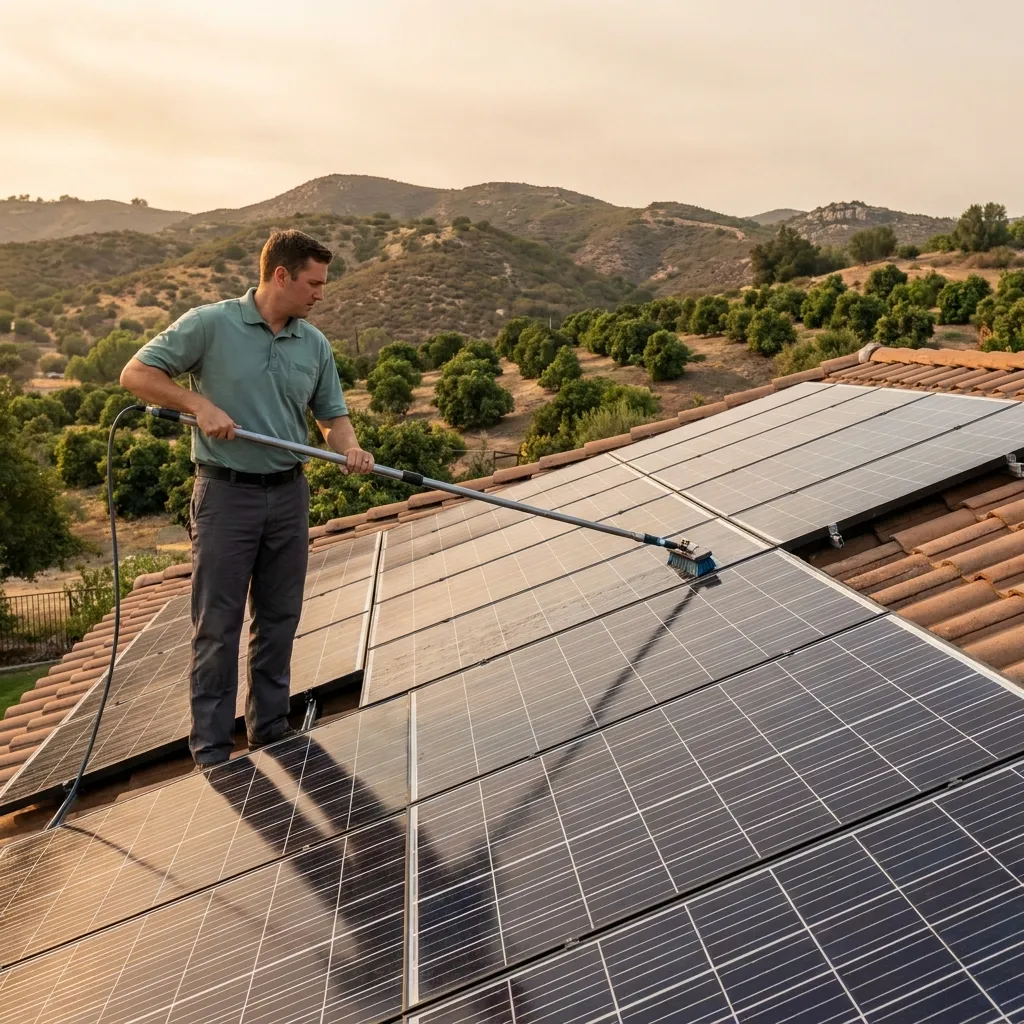
Soft-brush water-fed pole system. This is the industry standard for residential work. Purified or deionized water is pumped through a soft-bristle brush on an extendable pole. It scrubs away buildup without scratching the anti-reflective coating and leaves no mineral residue when it dries.
Hard water stain treatment. If sprinkler spots or evaporated dew has left calcium deposits, we apply a pH-appropriate treatment to dissolve the minerals before the main wash.
Post-clean inspection and report. We document panel condition, flag anything that needs an installer’s attention, and note what we found so you have a baseline for the next visit.
We do not use pressure washers. High pressure forces water into frame seals, can chip glass edges, and voids most manufacturer warranties. Our residential solar cleaning service uses only manufacturer-safe methods.
Does rain clean solar panels in Vista?
Not reliably, and not inland. A heavy downpour can wash off loose surface dust, but Vista averages around 12 to 14 inches of rain per year, most of it concentrated in December through March. A light rain often makes things worse: it mobilizes dirt, which then dries in streaks and rings across the panel surface.
The pollen, sap, and hard water deposits that accumulate over a Vista dry season require mechanical agitation and treated water to fully remove. Rain alone will not handle them. Our post about how often to clean solar panels in San Diego covers the rainfall argument in more depth if you want the full picture.
Signs your Vista panels are overdue for a cleaning
You do not always need to get on the roof to know it’s time. Watch for:
- Output drop of 5 percent or more compared to the same month last year (check your inverter app)
- Visible brown or white streaking visible from the ground
- Bird activity on or around the array
- A dry summer stretch of 60-plus days with no rain
- Ash fall from a nearby wildfire
Our solar panel cleaning service page for Vista has more detail on local conditions and what to expect from a first-time cleaning.
When to call us
If your Vista panels have gone more than six months without a cleaning, or you’ve noticed an output dip you can’t explain, it’s worth scheduling a service before the summer heat peaks and your system is working hardest. Call us at (858) 925-5546 for a free Vista solar cleaning quote. We serve all Vista neighborhoods, including Shadowridge, Vista Village, Buena Vista, and the surrounding North County hills.